

Online Rent Collection Made Simple
- Set up rent payments
- Invite tenants
- Collect payments online
- Get paid to your bank account
- Monitor every transaction
Table of Contents
Prorated rent is something almost every landlord deals with. It comes up when a lease starts on a date that isn’t the first of the month, e.g. when a tenant moves in mid-month or a start date shift.
This often leads to a simple question: how much rent should you charge for those first partial days?
Getting it right is important. It helps you stay fair, avoid confusion, and start the tenancy on good terms. In this guide, you’ll learn what prorated rent is, how to calculate it using two common methods, when to collect it, and how to document it clearly.
What Is Prorated Rent?
Prorated rent is a partial payment charged when a tenant occupies a unit for only part of a billing cycle, typically during a move-in or move-out month. Instead of charging a full month rent for 10 days of occupancy, you calculate the exact amount owed based on the daily rate.
While Canadian law doesn’t mandate this practice, most provinces expect landlords to bill fairly. Many provincial tenancy acts, including Ontario’s Residential Tenancies Act, set out rules around what can and cannot be charged at the start of a tenancy. Charging a full month’s rent for a partial stay could be challenged as an overcharge. Prorating avoids that risk entirely.
When Does Prorated Rent Apply?
There are three common scenarios where this applies:
Mid-month move-in. This is the most frequent situation. A tenant’s lease begins on the 14th, not the 1st. Instead of paying for a full month, they pay for the remaining days of that month. Starting the following month, rent is due on the 1st as normal.
Mid-month move-out. A tenant gives proper notice and vacates on the 22nd. They owe rent only for those 22 days, not the full month. Collecting a full month in this case is unfair and can be legally challenged.
Lease modifications or delayed possession. If a unit isn’t ready on the agreed date due to repairs or a previous tenant’s holdover, any days of delayed possession should be prorated off the first rent payment. This protects your reputation and keeps you on the right side of tenancy law.
Two Methods for Calculating Prorated Rent
There is no single nationally mandated formula, but two methods are widely used. Both are legitimate.
Method 1: Actual Days in the Month
This is the most common and transparent approach. You divide the monthly rent by the actual number of days in the month the tenant is moving in or out.
Formula: (Monthly Rent ÷ Days in the Month) × Days Occupied = Prorated Rent
Example: A tenant moves into a $1,800/month unit on June 16. June has 30 days, and the tenant will occupy the unit for 15 days (June 16 through June 30).
- Daily rate: $1,800 ÷ 30 = $60.00/day
- Prorated amount: $60.00 × 15 = $900.00
This method is intuitive for tenants because it mirrors how they think about the month. If you stay for half of June, you pay half of June’s rent. Simple.
Important note for leap years: February has 29 days in a leap year. If a tenant moves in during that February, use 29 as your divisor. The difference is small but matters to precision and professionalism.
Method 2: Annual Daily Rate (365-Day Method)
This method calculates a consistent daily rate across the entire year, regardless of how many days are in a specific month.
Formula: (Monthly Rent × 12 ÷ 365) × Days Occupied = Prorated Rent
Example using the same scenario:
- Annual rent: $1,800 × 12 = $21,600
- Daily rate: $21,600 ÷ 365 = $59.18/day
- Prorated amount: $59.18 × 15 = $887.67
This method is more precise, as it reflects the true daily value of the tenancy rather than letting the result vary by whether it’s a 28-day or 31-day month. The tradeoff is that it’s slightly harder to explain to a tenant on the spot.
Which method should you use? Method 1 (actual days) is better for simplicity and tenant clarity. Method 2 (annual rate) is better for precision across a long-term lease. Either works if you use a prorated rent calculator or double-check your math before presenting numbers to a tenant.
What To Include In The Lease Agreement
The most common source of billing disputes isn’t math, but the lack of written documentation. Protect yourself and your tenant by including the following in every lease:
- The prorated amount in currency
- The calculation method used
- The dates of the partial period
- The due date of prorated amount
Simplify Rent Collection With Royal Invest
Calculating the partial amount manually works for a single unit. Managing it across multiple properties, move-in dates, and currencies is where errors creep in.
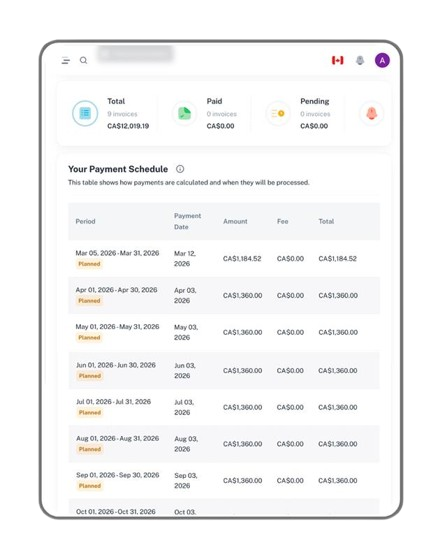
Rent collection with Royalinvest.ca handles this automatically. When you set up a new tenancy, you define the move-in date, billing cycle, and monthly rent. The platform calculates the prorated amount for the first partial month, generates an invoice for the tenant, and schedules subsequent full payments from the first of the month onward, without manual input.
Tenants can pay by bank transfer or card directly through the platform. Invoices and receipts are generated automatically. Payment reminders go out before due dates, and every transaction is logged in your dashboard, keeping your records clean for tax time or tenancy board review.
Also, read:
- How to Connect Bank Account to Royalinvest.ca for Online Rent Payments (Step-by-Step Guide)
- Property Manager or DIY? 9 Questions to Help You Decide
- Questions To Ask Tenants Before Credit Check
FAQ
Do landlords have to charge prorated rent?
No, it is not always legally required, but it is widely expected as a fair practice. Charging only for the days a tenant actually occupies the unit helps prevent disputes, supports transparency, and aligns with general tenancy rules that discourage overcharging for periods when the unit is not fully used.
Should prorated rent be paid before move-in?
In most cases, prorated rent should be collected before or on the move-in date. This ensures the tenant has paid for the exact period they will occupy the unit. Collecting it upfront also reduces payment risk and keeps your rent schedule aligned with standard monthly billing cycles from the start.
Is prorated rent calculated the same way for move-out?
Yes, the same calculation method is typically used when a tenant moves out mid-month. You determine the daily rate and charge only for the number of days the tenant occupied the unit. This keeps billing consistent and ensures tenants are not charged for days after they have vacated the property.
Can tenants refuse to pay prorated rent?
Tenants generally cannot refuse to pay prorated rent if it is clearly outlined in the lease and calculated correctly. Clear communication, written terms, and transparent calculations help prevent disagreements. If the amount is fair and documented, it is considered a standard and enforceable part of rent obligations.
How do you avoid mistakes when calculating prorated rent?
To avoid mistakes, use one consistent calculation method and double-check all numbers before sharing them with the tenant. Clearly document the dates, daily rate, and final amount in the lease. Many landlords also use software or calculators to automate prorated rent and reduce the risk of manual errors.




Leave a Reply