

Table of Contents
Running a credit check for rental application decisions should never feel like guessing. A well-structured tenant screening report helps landlords review risk, confirm whether an applicant appears financially consistent, and decide what follow-up checks are needed before approving a lease. The Royal Invest credit report is designed to make that process easier by turning credit bureau data into plain-language sections landlords can use.
Still, a report should not be treated as a final verdict. A landlord run credit check is one part of a responsible screening process that should also include identity verification, income review, landlord references, and a consistent approval policy. In Canada, landlords generally need written applicant consent before pulling a tenant credit report, and the information should be handled carefully because it contains sensitive personal data.
Why Landlords Should Read More Than The Score
Many landlords start with the credit score because it is simple and familiar. But the most useful insights are often found in the sections behind the score: payment consistency, credit utilization, collections, public records, inquiries, and the applicant’s overall credit experience. A lower score with clean recent payments may be less concerning than a higher score supported by only a thin history. Likewise, one older issue may matter less than a pattern of repeated missed payments.
The Royal Invest report helps landlords avoid overreacting to a single number by presenting a summary, status result, risk index, score band, and section-level explanations. This format is especially useful for independent landlords who need a practical way to review tenant risk without becoming credit analysts.
Start With The Report Header And Consent Context
The first part of the Royal Invest report identifies the date and time, report ID, company details, and privacy notice. In the sample report, the file was generated on August 20, 2025, and includes a unique report ID. For landlords, these details matter because tenant screening should be timely, traceable, and based on the correct applicant file.
Check that the report date is recent enough for your policy. A credit report from several months ago may miss new debt, recent late payments, or new inquiries. Also confirm that the applicant gave consent for the credit check for rental application screening. Consent protects both the applicant and the landlord by making the purpose of the check clear.
Landlord Action: Save the report ID with the application file, confirm the report is recent, and do not proceed unless the applicant has clearly authorized the credit check.
Review The Applicant Identity And File Match
The report identifies the applicant’s first and last name, rental property address, and whether the file matches credit bureau data. In the sample, the file match is marked “Yes,” meaning the applicant was found in the database. This is an important early checkpoint. If the file does not match, the landlord may need to verify spelling, date of birth, address history, or identification before relying on the results.
A file match does not replace identity verification. It simply indicates that the credit data connects to the applicant for details provided. Landlords should still compare the application, government ID, proof of income, and references to make sure the person applying is the same person being screened.
Before relying on the result, compare the report details with the rental application, ID, proof of income, and references.
Understand The Status Result And Risk Index
The Royal Invest sample report shows a status of “PASS” and a risk index of 40, described as moderate. The summary states that the landlord can move forward because no major or recent issues appeared and the overall picture looks steady and responsible. This is helpful, but it should be read as a screening recommendation rather than a lease of approval by itself.
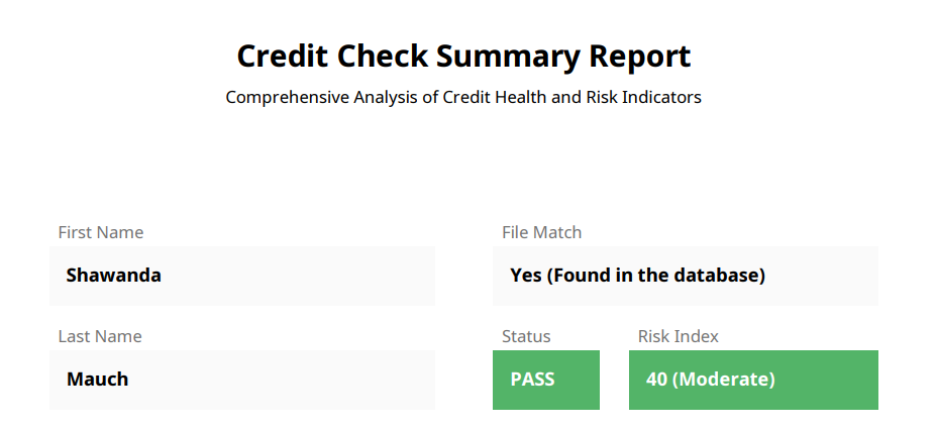
A moderate risk index tells the landlord to keep reviewing the full application. For example, if income is strong, employment is stable, and references are positive; a moderate file may still be acceptable. If the applicant’s income is tight or the rental history is unclear, the same report may justify asking for additional documentation within the limits of your local rules and rental policy.
Landlord Action: Treat the PASS status as permission to continue screening, not as final approval. Use the risk index to decide whether standard checks are enough or whether extra verification is needed.
Read The Credit Scores And Ratings Section
The credit scores and ratings section convert the applicant’s credit profile into a letter-style rating, plotted against the wider pool of files the bureau holds. In the sample, a “B” rating sits within the upper portion of that range, generally reliable, with room for occasional blemishes or a shorter credit history. While grades below it (C, D, F) reflect progressively more of the applicant pool and typically call for closer review. The report recommends approving only standard checks and considering a quick reference if rent-to-income is tight.
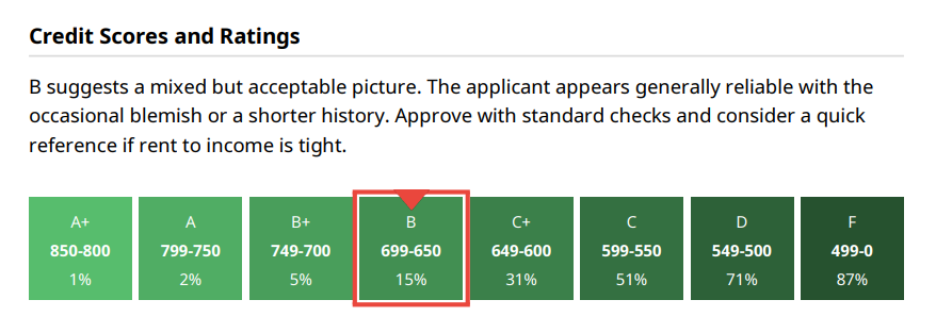
This is where landlords should resist the temptation to use a fixed score cutoff without context. A strong screening process looks at whether the applicant pays obligations on time, whether debt appears manageable, whether negative items are recent, and whether the applicant can comfortably afford the rent. A landlord run credit check gives powerful context, but fair decision-making depends on applying the same criteria to every applicant.
Landlord Action: Use the rating as a starting point, then review payment history, income strength, debt pressure, and rental references before making a final decision.
Evaluate Credit Health And Debt Pressure
The credit health section explains whether the applicant’s credit usage looks stable or stressed. In the sample report, the picture is described as mixed, with some positive accounts, some past-due amounts, and a moderate share of available credit in use. This does not automatically mean a decline. Instead, it tells the landlord to compare credit activity with income and current obligations.
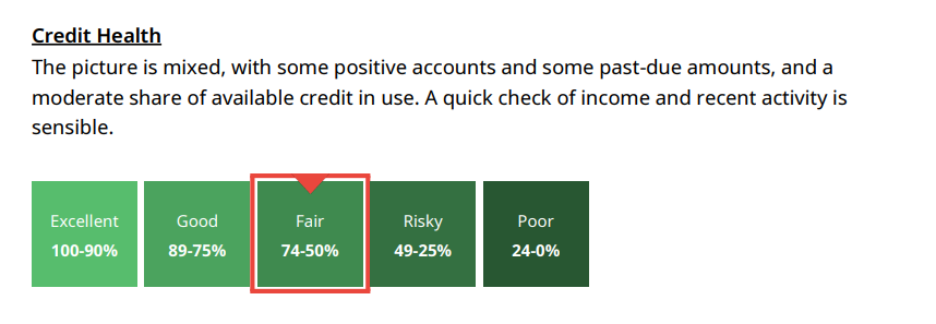
For practical screening, ask: does the applicant have enough verified income after debt obligations to cover rent comfortably? Are balances close to their limits? Are past-due amounts isolated or repeated? High utilization may signal short-term financial pressure, especially if paired with missed payments. Moderate utilization with consistent payments may be less concerning.
If credit health looks strained, request current income documents and compare monthly rent against the applicant’s likely debt obligations.
Check Credit Management For Patterns
Credit management looks beyond the score and focuses on how the applicant manages accounts over time. The Royal Invest sample notes a limited credit mix, uneven reliability, several accounts not in good standing, more than one missed payment, and balances that may be pushing limits. This is one of the more important sections for landlords because repeated strain can affect rent reliability.
If this section raises concerns, landlords can still respond proportionately. You might request stronger income proof, speak with current or previous landlords, confirm whether issues are old or resolved, or ask the applicant to explain recent negative marks. The goal is not to punish financial imperfections. The goal is to understand whether the applicant is likely to pay rent on time and maintain the lease responsibly.
Landlord Action: Look for repeated behavior rather than one isolated issue. If several accounts show problems, ask for context and consider stronger verification before approval.
Assess Credit Experience And Account Depth
Credit experience shows whether the applicant has enough history to judge financial behavior. The sample report describes established history with a healthy mix of account types, and most accounts open for a reasonable time. For landlords, this is a positive sign because longer account history gives more evidence of how the tenant handles obligations.

Applicants with limited history are not necessarily risky. Newcomers, students, young professionals, and people who avoid credit may have thin files for legitimate reasons. In those cases, landlords should place more weight on income, employment, rent payment references, savings evidence where appropriate, and clear communication.
If credit history is thin, rely more heavily on verified income, rental references, employment stability, and any permitted supporting documents.
Prioritize Payment Consistency
Payment consistency is often the most landlord-relevant part of a credit report. In the Royal Invest sample, payments appear on time across accounts with no late marks, supporting confidence in regular rent payments once income and ID are verified. This is the kind of detail that gives context to the broader risk rating.
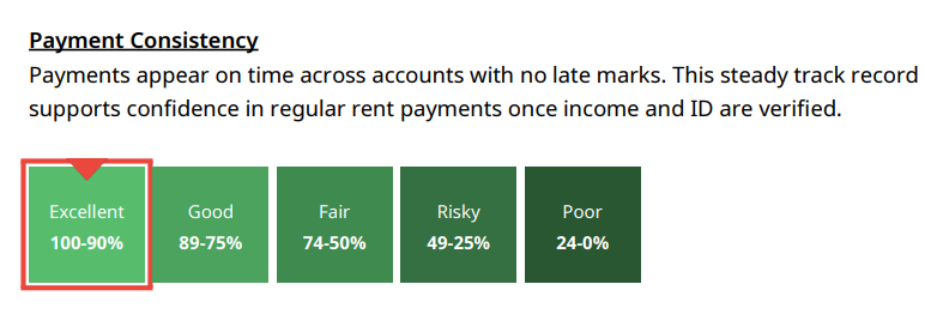
When reading this section, focus on patterns and recency. One older late payment followed by years of on-time payments may not carry the same risk as several missed payments in the last few months. Recent unpaid obligations, repeated late marks, or accounts moving into collections deserve closer review before approval.
Landlord Action: Give the most weight to recent payment patterns. Recent missed payments should trigger closer review, while older isolated issues may need only a brief explanation.
Interpret Credit Inquiries Carefully
The inquiry section shows whether the applicant has recently applied for new credit. The sample report marks inquiry volume as low and notes that no hard inquiries appear within the past year. This is generally reassuring because it does not suggest active credit seeking or several recent applications for new debt.
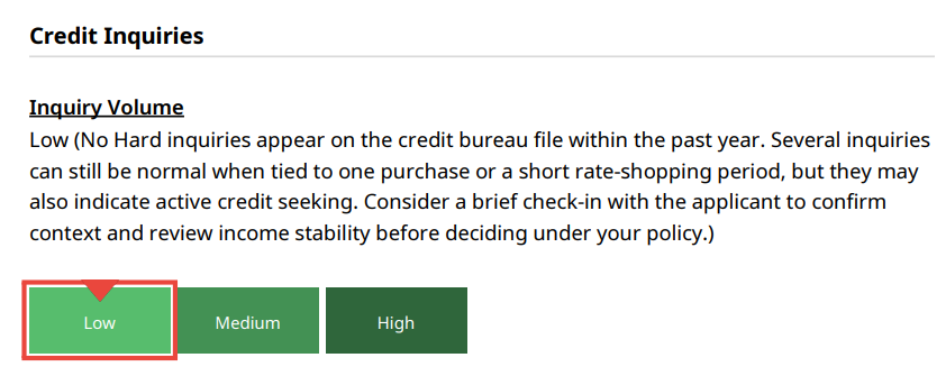
If inquiries are high, avoid assuming the worst. Multiple inquiries can sometimes be normal when someone is shopping for a car loan, mortgage, or rate comparison within a short period. Ask for context and compare the answer with the rest of the application. A thoughtful credit check for rental application review separates reasonable life events from signs of financial instability.
Landlord Action: If inquiries are low, continue with standard screening. If they are high, ask whether the applicant was rate-shopping, moving, or applying for necessary credit recently.
Use The Summary As A Decision Guide, Not A Shortcut
The Royal Invest summary is valuable because it translates the report into plain language. In the sample, it says the applicant looks like a good fit for renting, while still reminding the landlord to complete usual income and ID checks. That balance is exactly how tenant screening should work: credit data informs the decision, but it does not replace the full process.
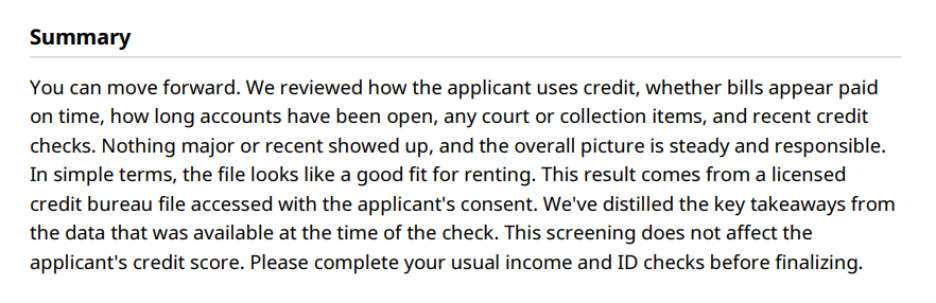
Before approving, landlords should confirm the applicant can afford the rent, verify employment or income, contact references, review rental history, and document the reason for the decision. A consistent checklist protects against rushed decisions and helps ensure every applicant is evaluated fairly.
Landlord Action: Make the final decision only after combining the report summary with income verification, ID checks, references, rental history, and your written screening criteria.
Run A Credit Check For A Rental Application On Royal Invest
Reading a report is only useful once you have one in hand. On Royal Invest, you are the one who pulls the credit check: you send the applicant an invitation to submit their consent and identity details through your dashboard, choose who covers the fee, and once the applicant has submitted their consent and ID,
Royal Invest generates the report for you to review. The applicant’s role is limited to providing consent and identification; the request, the fee decision, and the resulting report all belong to you. From there, you’re reading exactly the sections covered here, ready to combine your income, ID, and reference checks before making a final call.
Frequently Asked Questions
Can a landlord run a credit check without consent?
No. A landlord should get clear written permission before ordering or receiving a tenant credit report. The consent should explain what will be checked, why it is needed, and how the information will support the rental decision.
Does a tenant credit check affect the applicant’s credit score?
The Royal Invest sample says its screening does not affect the applicant’s credit score. Still, landlords should confirm how their provider handles inquiries and explain the process before collecting consent, especially if applicants worry about applying for multiple rentals.
Should a landlord decline an applicant based only on credit?
Usually, no. Credit should support the decision, not replace the full screening process. Landlords should also review income, identity, rental history, references, and consistent approval criteria. This helps avoid assumptions and keeps decisions fair across applicants.
How often should a landlord request a new report?
Use a current report for each active application. If the decision is delayed or the applicant reapplies later, request an updated credit check for rental application review with fresh consent so the decision reflects their latest financial picture.




Leave a Reply