

Table of Contents
When a rental application lands on your desk, the numbers on it are trying to answer one question: can this person afford the rent, month after month? The income-to-rent ratio is the fastest way to check. It compares an applicant’s gross income to the monthly rent, and it’s the same math behind the well-known “3x rent rule” used by landlords across Canada and the US.
Used well, the ratio flags financial risk before a lease is signed, it can also screen out good tenants or expose a landlord to a human-rights complaint. This guide covers where the ratio comes from, how to calculate it, and where it needs to stop being the whole story.
Key Takeaways
- The income-to-rent ratio compares gross monthly income to monthly rent. The “3x rent rule” and the CMHC 30% shelter-cost guideline describe roughly the same threshold from two different angles.
- A ratio below 3x doesn’t automatically mean “reject”, strong credit history, savings, or a co-signer can offset it.
- In Ontario, income information cannot legally be the sole screening criterion, it has to be weighed alongside credit history, rental history, and references.
- High-cost rental markets often use 2.5x or 3.5x instead of a rigid 3x, and vouchers or subsidies change the math again.
What Is the Income-to-Rent Ratio?
The income-to-rent ratio is a simple affordability filter: how many times does an applicant’s gross monthly income cover the rent?
Income-to-Rent Ratio = Gross Monthly Income ÷ Monthly Rent
A ratio of 3.0 means the applicant earns three times the monthly rent before taxes. Most landlords treat 3x as the baseline and use it as a first-pass filter rather than a final verdict, which is exactly how it should be used.
Where the “3x Rent Rule” Comes From
The 3x figure isn’t a law; it’s an industry convention that lines up closely with a well-established housing-affordability benchmark. CMHC (Canada Mortgage and Housing Corporation) defines affordable housing as costing less than 30% of a household’s gross income. Flip that percentage into a ratio, and it lands at roughly 3.3x: close enough to 3x that the two guidelines are effectively describing the same line from different directions.
That overlap is useful context for landlords: a tenant paying at or below the 3x threshold is, by the same math public housing agencies use, spending an affordable share of their income on shelter. A tenant well below it is more likely to be financially stretched before rent is even due.
How to Read the Ratio: Benchmark Table
Here’s how the common ranges break down in practice:
| Ratio | Approx. % of Income on Rent | What It Signals |
| Below 2.5x | Over 40% | High risk: rent may crowd out other essentials; look closely at savings and debt. |
| 2.5x – 3x | 33% – 40% | Borderline: worth weighing alongside credit history and references. |
| 3x – 3.5x | 28% – 33% | Standard threshold most landlords use as a baseline PASS. |
| 3.5x and above | Under 28% | Strong affordability cushion. |
Worked example: on a $1,500/month rental, a 3x threshold means looking for roughly $4,500 in verified gross monthly income: about $54,000 per year.
Why This Ratio Matters for Landlords
Rent arrears are expensive to unwind. Between lost rent, the time cost of the eviction process, and re-listing the unit, a single bad placement can erase months of profit on a property. The income-to-rent ratio doesn’t prevent every problem tenancy, but it removes the most common one: a tenant who was never earning enough to sustainably cover rent in the first place, even before job loss or an emergency expense enters the picture.
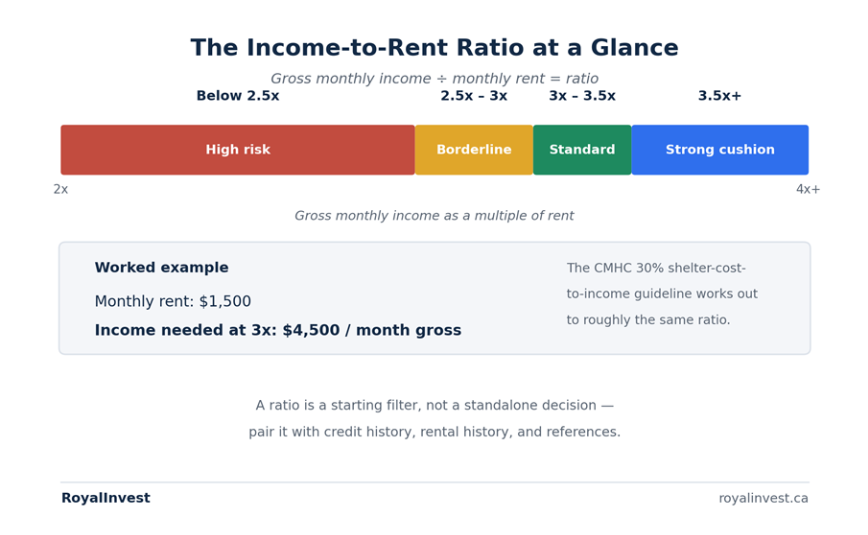
Figure 1: Income-to-rent ratio bands, from high risk to strong cushion.
A Royal Invest free tenant screening shows the income-to-rent ratio automatically for every applicant.
What the Ratio Doesn’t Tell You
A healthy ratio is a starting point, not a guarantee. It says nothing about:
- Existing debt obligations that also draw on the same income (a debt-to-income view, not just income-to-rent).
- Job stability: a new contract role and a decade-long salaried position can produce the same ratio.
- Payment history: which is what a credit report captures, and income alone does not.
This matters legally, too. In Ontario, human rights guidance is explicit that a rigid income cut-off, applied on its own with no consideration of other factors, can amount to discrimination: particularly where it disproportionately screens out applicants relying on social assistance or other protected sources of income. The guidance calls for income information to be considered together with credit history, rental history, and references, not as a standalone pass/fail gate. Treat the ratio as one input among several and document the other factors you weighed.
Adjusting the Threshold for Different Situations
- High-cost markets: in cities where rent consumes a larger share of typical incomes, some landlords soften the threshold to 2.5x, provided other financial indicators are strong.
- Co-signers and guarantors: when an applicant falls short on income alone, a qualified co-signer’s income can be added to the calculation.
- Rent subsidies and housing benefits: where a portion of rent is covered by a subsidy or benefit, the ratio should be calculated against the tenant’s actual out-of-pocket share, not the full rent, and source-of-income protections may apply to how that income is treated during screening.
How Royal Invest Takes the Guesswork Out of This
The hardest part of using an income-to-rent ratio isn’t the math, it’s applying it the same way, every time. Under time pressure, it’s easy to eyeball one applicant’s pay stub and do a full calculation for another, or to lean on the ratio alone and skip a proper look at credit or rental history. That inconsistency is exactly what creates risk: it’s how a genuinely qualified applicant gets turned away on a technicality, and it’s the pattern human-rights guidance warns against when income is treated as a stand-alone gate.
The Royal Invest’s free tenant screening removes that inconsistency by showing the ratio , the same way, for every applicant, as part of the questionary that the tenants fill in. There’s no separate spreadsheet to maintain and no risk of the math being skipped when things get busy.
In practice, that turns a step landlords often do inconsistently or skip into a routine part of screening every applicant the same way.
Frequently Asked Questions
What is a good income-to-rent ratio?
Most landlords in Canada and the US treat 3x the monthly rent in gross income as the standard benchmark, roughly equivalent to spending 30–33% of income on rent.
Is 2.5x rent enough income to qualify for an apartment?
It can be, especially in higher-cost markets or when other factors, strong credit history, low debt, savings, or a co-signer, offset a lower ratio. It’s more commonly treated as borderline than an automatic pass.
Can landlords legally require 3x the rent in Canada?
Using an income guideline is generally permitted, but it cannot be the only screening factor. In Ontario specifically, human rights guidance requires that income be weighed alongside credit history, rental history, and references rather than used as a rigid, stand-alone cut-off.
Should landlords use gross or net income for the ratio?
Gross (pre-tax) income is the standard input, since it’s the figure most consistently documented across pay stubs, employment letters, and tax records.
What if an applicant doesn’t meet the ratio?
Consider the full picture before declining: a co-signer, a larger security deposit where legally permitted, prepaid rent, or strong credit and rental history can all offset a lower ratio.
Resources
CMHC: About Affordable Housing in Canada
Ontario Human Rights Commission: Policy on Human Rights and Rental Housing




Leave a Reply