

Table of Contents
No law sets a minimum credit score for renting a home. Each landlord chooses their own bar, and in Canada a widely used reference point is 660, which runs from 300 to 900. Applicants at or above it is generally seen as acceptable, lower-risk borrowers. as acceptable, lower-risk borrowers.
That figure is a starting point, not a verdict. Bureaus draw their bands in different places, a score ignores income entirely, and a 650 on a clean report can be a safer bet than a 680 with a fresh collection. Below: where the score bands fall in Canada and the US, why a single cut-off misleads, and how to set a minimum that holds up.
Key Takeaways
- No law sets a minimum credit score for tenants. Landlords choose their own, and a widely used Canadian reference point is 660, where Equifax’s “good” band begins.
- Scales differ. A 700 is “good” on Equifax and FICO but only “fair” on TransUnion Canada, so the bureau and model behind a number matter as much as the number.
- Credit scores leave income out, so a score belongs next to income verification and rental history, not in place of them.
- The report says more than the score. Recent late payments, collections, and heavy debt outweigh a score sitting a few points under a cut-off.
- A free Royal Invest tenant screening covers the basics first, and the credit check adds the detailed bureau data behind the decision.
SCREEN EVERY TENANT THE SAME WAY
See What’s Behind the Score Number
A score is a summary. The bureau data behind it shows whether a low number is a thin file or a pattern of missed payments, and that difference is what protects your rent.
What Counts as a Good Credit Score for a Rental Applicant
In Canada, 725 to 759 as very good, and 760 and above as excellent. Scores from 560 to 659 are fair, and anything below 560 is poor. Because lenders generally treat 660 and up as acceptable or lower risk, many landlords adopt the same line as their minimum.
It is a convention, not a rule. A landlord renting a premium unit may ask for more. One in a softer market may accept less when income and references are strong.
Credit Score Ranges in Canada and the US
The word “good” shifts with the scoring scale. TransUnion Canada’s bands start “good” at 743, well above Equifax’s 660. In the US, FICO calls 670 to 739 good on a 300–850 scale, while VantageScore sets its good range at 661 to 780. An applicant scoring 700 is in the good band on Equifax and FICO, and in the fair band on TransUnion.
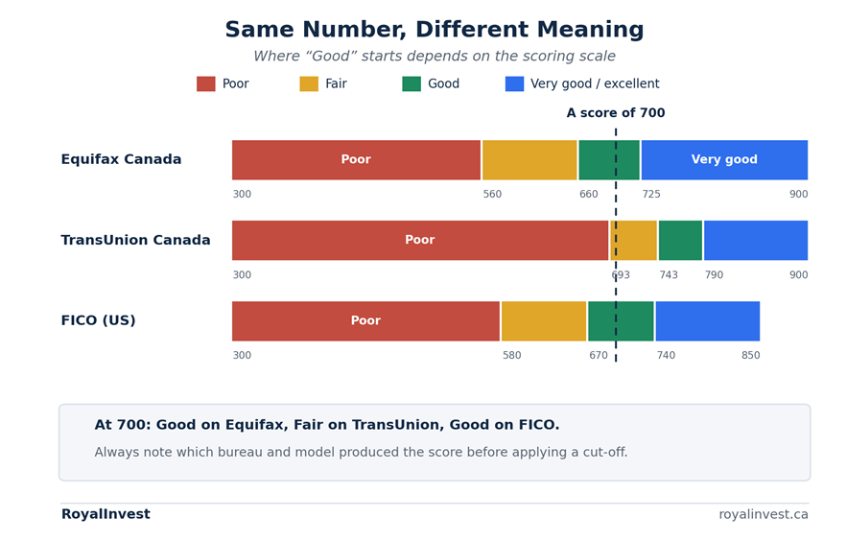
Figure 1: The same score can fall in different bands depending on the bureau or model.
Why a Single Cut-Off Can Mislead
- Different bureaus, different numbers. The same person can hold different scores at each bureau, because lenders do not report to every bureau, reports update at different times, and the models differ.
- No income in the score. Credit scoring does not factor in income, so an applicant can score well and still earn too little for the rent or score modestly and earn comfortably.
- Thin files look like weak files. Students, newcomers, and young renters may have a low score or none simply because there is little history to score.
What to Read Beyond the Number
Open the report and look for the patterns a single score flattens:
- Recent late payments. A missed payment in the last 12 to 24 months says more than an old blemish that has since healed.
- Collections. Unpaid rent, utilities, or telecom accounts reveal the exact behavior a landlord cares about, more than a high card balance does.
- Debt load against income. A score does not capture it; Debt-to-Income Ratio: What It Tells a Landlord Beyond the Credit Score shows how to measure it.
- Length of history. It separates a thin file from a troubled one.
Typical Screening Response by Score Band
Using the Equifax Canada bands as the reference, landlords commonly respond as follows. Treat the table as a guide, not a rule:
| Score Band | Rating | Typical Landlord Response |
| 760 and up | Excellent | Strong credit signals. Focus on remaining effort on income and rental history. |
| 725 – 759 | Very good | Strong. Proceed with the standard income and reference checks. |
| 660 – 724 | Good | Generally acceptable. Standard checks, with a quick read of the report for red flags. |
| 560 – 659 | Fair | Read the report closely. Recent late payments or collections may call for extra references or a guarantor. |
| Below 560 | Poor | Elevated risk. Understand the reasons, then consider a qualified guarantor or other safeguards, applied consistently. |
How to Apply a Minimum Fairly
Set the bar before applications arrive and apply it to everyone. In Ontario, human rights guidance calls for credit and income information to be weighed together with rental history and references rather than used as a single pass/fail gate. Written criteria, and a short note of the reasons behind each decision, keep the process consistent and easy to defend.
US landlords have one more step. Under the Fair Credit Reporting Act, an applicant is entitled to an adverse action notice when information in a consumer report leads to a denial, or to a burden such as a co-signer or a higher deposit, as FTC guidance for landlords explains.
How Royal Invest Takes the Guesswork Out of This
Most landlords are not credit analysts. Faced with a raw number, they compare it to a cut-off they half remember, wonder whether 655 really differs from 665, and puzzle over account codes. Decisions end up resting on instinct, and instinct varies from one applicant to the next.
Royal Invest splits the job into two steps. A free tenant screening gives basic information first, so there is no spending on detail for an applicant who was never a fit. When the full picture is needed, the RoyalInvest credit check pulls real bureau data with the tenant’s consent, no account needed on their end, and returns a plain-language summary with a risk level and a clear PASS/FAIL recommendation in minutes.
Every applicant gets the same read, which leaves a landlord’s attention free for the parts only a person can judge. Once someone clears, the next step is an official lease agreement on the same platform.
Frequently Asked Questions
What credit score does most landlords require?
There’s no legal or universal minimum, so each landlord sets their own. In Canada, many use the start of the “good” range on the Equifax scale, around 660, as a reference point, while weighing income, rental history, and references alongside it. A score alone rarely settles for an application.
Can a landlord reject an applicant for a low credit score alone?
Credit can be part of the decision, but relying on it alone is risky. In Ontario, human rights guidance says credit and income information should be weighed together with rental history and references rather than used as a single cut-off. A documented, consistently applied process is the safer approach.
Is a 650-credit score good enough to rent?
It often can be. On Equifax’s scale, 650 sits in the “fair” band just below “good” at 660, so the report matters more than the number. Look for recent late payments or collections, check out income and rental history, and consider a guarantor if the file is thin, or the risk feels uncertain.
What if an applicant has no credit score?
A missing score usually means a thin file, common for students and newcomers, not a bad one. Ask for rental references, verified income, and proof of on-time payments elsewhere, and consider a qualified guarantor. Treat every applicant with no history the same way, so the standard stays consistent and defensible.
Do Equifax and TransUnion scores match?
Rarely. Both use a 300–900 scale in Canada, but their models and band cut-offs differ, so the same person can have different scores. A 700 is “good” on Equifax’s scale yet “fair” on TransUnion’s. Note which bureau produced the number before comparing it with any minimum.




Leave a Reply