

Table of Contents
A high credit score feels reassuring, but it only answers one question: has this person paid bills on time in the past? It says nothing about how much of their income is already spoken for by existing debt.
The debt-to-income ratio (DTI) fills that gap. Comparing total monthly debt payments to gross income, it shows whether an applicant has real room to take on rent, a different question than whether they’ve been reliable before, or whether their income alone covers this specific rent. This guide explains what DTI is, how it differs from a credit score and the income-to-rent ratio, and how to read it as a landlord.
Key Takeaways
- DTI equals total monthly debt payments divided by gross monthly income, a different calculation than the income-to-rent ratio, which looks only at rent.
- Credit scores do not factor in income at all, so a strong score can sit right next to an applicant whose income is already heavily committed to other debt.
- Canadian mortgage lenders use two DTI variants, GDS and TDS, with federal guidelines capping TDS at 44% for insured mortgages.
- US lenders commonly treat 43% DTI as the ceiling for a Qualified Mortgage; a useful reference point landlords can borrow for tenant screening.
- Credit score, income-to-rent ratio, and DTI each catch something the others miss, using all three gives a materially fuller picture than any one alone.
READY WHEN YOU ARE
Screen With the Full Financial Picture
Get a real credit report, the debt data behind the score, and the income-to-rent ratio in one report — then send an official lease the moment an applicant clears.
What Is Debt-to-Income Ratio?
Debt-to-Income Ratio = Total Monthly Debt Payments ÷ Gross Monthly Income
As the Consumer Financial Protection Bureau explains, this adds up every recurring monthly debt obligation, car loans, student loans, credit card minimums, other rent or mortgage payments, and divides it by gross monthly income. The result is a single percentage representing how much of an applicant’s income is already committed before rent even enters the picture.
Why Credit Score Alone Doesn’t Capture This
It’s a common assumption that a strong credit score implies healthy finances overall. It doesn’t necessarily. Credit scoring models do not include income as a factor: income isn’t even part of the data in a standard credit report. A score is built from payment history, amounts owed, length of credit history, credit mix, and new credit applications. None of that reflects what percentage of someone’s paycheque is already committed elsewhere.
That means an applicant can have an excellent score built on years of on-time payments, while simultaneously carrying a car loan, a line of credit, and student loan payments that leave very little actual room for rent. The score alone won’t surface that; the debt figures behind it will.
How Canadian Lenders Use DTI: GDS and TDS
Canadian mortgage lenders don’t use a single DTI number, they split it into two ratios, both defined in federal mortgage-insurance guidelines:
| Ratio | What It Includes | Typical Ceiling |
| GDS | Housing costs only: mortgage, property tax, heat, condo fees | 39% |
| TDS | Everything in GDS, plus all other debt payments | 44% |
Those figures come from the Financial Consumer Agency of Canada’s mortgage qualifier tool. TDS is the most useful reference point for tenant screening, since it’s the one that accounts for every other debt obligation, not just housing. The same logic applies directly to rent instead of a mortgage payment, use the proposed rent, and instead of a 44% mortgage-lending ceiling, treat a similar threshold as a signal worth a closer look.
Worth a Look:
- What Counts as Proof of Income on a Rental Application
- Why the Income-To-Rent Ratio Matters When Screening a Tenant
- How Online Rent Collection Simplifies Property Management
How to Calculate an Applicant’s DTI for Tenant Screening
Here’s how the same applicant can look different depending on which number is used:
| Item | Monthly Amount |
| Gross monthly income | $6,000 |
| Car loan payment | $350 |
| Student loan payment | $200 |
| Credit card minimum payments | $150 |
| Proposed rent | $1,800 |
Income-to-rent ratio: $6,000 ÷ $1,800 = 3.33x, comfortably above the standard 3x threshold, looking like a straightforward PASS on its own.
Debt-to-income ratio: ($350 + $200 + $150 + $1,800) ÷ $6,000 = 41.7%, close to the 44% ceiling Canadian lenders treat as a limit, once every other debt obligation is added in.
The income-to-rent ratio alone makes this applicant look comfortable. The DTI calculation tells a tighter story: more than 40% of their income is already committed once existing debt is counted. Neither number is wrong, they’re just answering different questions, and a landlord relying on only one of them is working with half the picture.
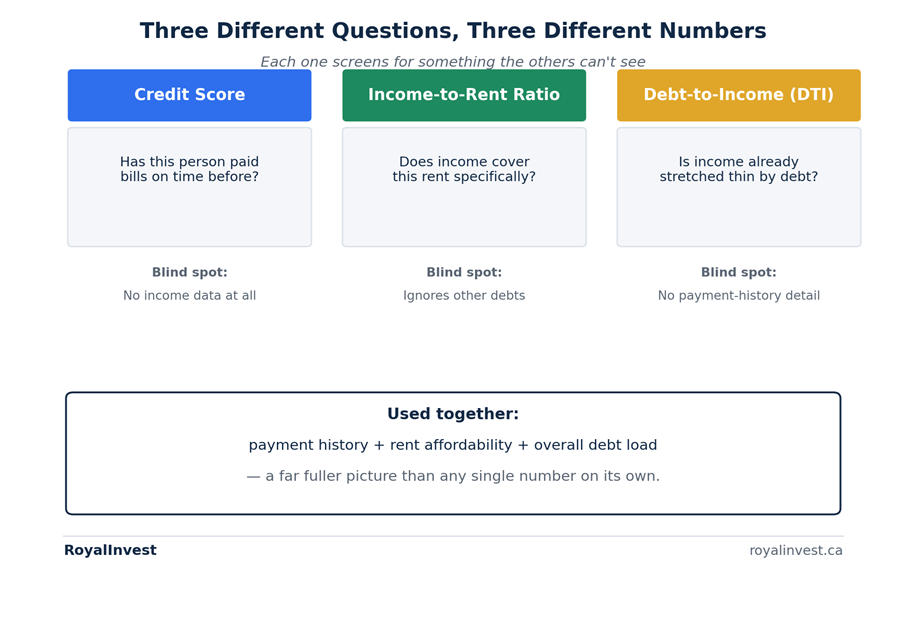
Figure 1: Credit score, income-to-rent ratio, and DTI each answer a different question.
READY WHEN YOU ARE
Screen With the Full Financial Picture
Get a real credit report, the debt data behind the score, and the income-to-rent ratio in one report — then send an official lease the moment an applicant clears.
Reading DTI Alongside the Income-to-Rent Ratio and Credit Score
None of these three numbers should be read in isolation:
- A strong credit score with a high DTI suggests someone who pays bills reliably, but with little financial slack: worth a closer look at total monthly obligations before approving.
- A comfortable income-to-rent ratio with a high DTI, as in the example above, means the rent itself is affordable on paper, but other debt is eating into that cushion.
- A moderate credit score with a low DTI can still be a reasonable risk: limited credit history isn’t the same as financial strain.
Where to Get the Numbers
A credit report already lists an applicant’s open credit accounts and their minimum monthly payments, car loans, credit cards, lines of credit, which is the debt side of the DTI calculation. The income side comes from verified documentation rather than a number on the application form, covered in the companion article, What Counts as Proof of Income on a Rental Application.
How Royal Invest Takes the Guesswork Out of This
Calculating DTI by hand means pulling debt figures from one document and income figures from another, then doing the math correctly, and it’s easy to miss a line item buried in a credit report, or to make an arithmetic slip under time pressure.
A Royal Invest tenant credit check surfaces the real bureau debt data behind the credit score alongside the income-to-rent ratio, in the same plain-language report, so a landlord isn’t reconciling two separate documents by hand to get a fuller view of an applicant’s finances. Run one from the RoyalInvest tenant credit check page, and once an applicant clears screening, move straight into an official lease agreement on the same platform.
Frequently Asked Questions
What’s a good debt-to-income ratio for a tenant?
There’s no single legal standard, but borrowing from Canadian mortgage-lending guidelines, a combined debt load (including the proposed rent) under roughly 40–44% of gross income is generally considered manageable. Above that range, it’s worth a closer look at the specific debts involved and how stable the applicant’s income is.
How is DTI different from the income-to-rent ratio?
The income-to-rent ratio only compares income to the rent itself. DTI goes further, adding every other recurring debt payment, car loans, student loans, credit cards, into the calculation. An applicant can pass one test comfortably while being much closer to the edge on the other, as the worked example above shows.
Does a credit score reflect debt-to-income ratio?
Not directly. A credit score is built from payment history, amounts owed, credit history length, credit mix, and new credit activity, it does not include income at all, so it can’t reflect what share of that income is committed to debt. A good score and a high DTI can exist side by side in the same applicant.
Where do landlords get the debt numbers for a DTI calculation?
A tenant credit report lists open credit accounts and their minimum monthly payments, which covers the debt side of the calculation. Income comes from verified documentation, pay stubs, an employment letter, or a Notice of Assessment, rather than a number typed into the application form.
Can a landlord legally decline an applicant based on DTI alone?
As with any single financial metric, DTI works best as one factor considered alongside credit history, rental history, and references, not as a stand-alone cut-off. Relying on one number in isolation, without weighing the full application, is both a weaker screening decision and a potential human-rights concern.




Leave a Reply