

Table of Contents
A credit report arrives in minutes as a number. A rental reference takes phone calls, and the answer depends on who picks up. When the two disagree, which deserves more weight?
Rental history is the closer predictor of how someone will pay rent, because it records that exact behavior. Credit history is the stronger tool for verification: standardized, objective, and hard to inflate. The best screening reads both and knows what to do when they point in different directions.
Key Takeaways
- Rental history is direct evidence of paying rent on time and caring for a home. Credit history is indirect evidence, but it is faster to obtain and easier to verify.
- Research on mortgage borrowers shows a clean housing-payment record predicts later repayment better than credit scores alone. Rent and mortgage payments are similar in size for most households, so the lesson carries over.
- Credit reports tend to penalize missed rent but ignore on-time rent, so a clean report does not prove a clean rental record.
- When the two disagree, the reason matters: a thin credit file with a spotless rent record is a very different case from good credit with a pattern of late rent.
- A free Royal Invest tenant screening covers the basics and the credit check adds the detailed bureau data, so your time goes into the reference calls.
Rental History Vs Credit History: The Core Difference
Rental history is direct evidence of the behavior a landlord needs: paying on time, giving notice, and looking after the home. Credit history is indirect evidence. It shows how someone handles borrowing, which often reflects how they will handle a monthly housing payment but does not guarantee it.
Each record also covers the other’s weak spot. A first-time renter has no rental history yet may have a solid credit file. A newcomer may have spotless references and no credit file at all. That is why the strongest screening uses both.
What the Research Shows
The clearest evidence comes from mortgage lending. Urban Institute researchers studied first-time homebuyers with Fannie Mae and Freddie Mac loans and found that housing-payment history, a proxy for rent payments, predicted mortgage performance significantly better than credit scores. Borrowers were tracked for two years, and the gap was wide:
| Borrower Group | Went 60+ Days Delinquent |
| FICO below 700, no missed payments | 4.0% |
| FICO below 700, one missed payment | 28.4% |
| FICO above 750, one missed payment | 11.7% |
A clean record on a lower score outperformed a single missed payment on a higher one. Fannie Mae went on to estimate that about 17 percent of first-time borrowers who would otherwise be declined could qualify with a clean 12-month rental payment history. The data measures mortgage performance rather than rent performance, but monthly rents are comparable to ownership costs for most income groups, which is why the researchers expect the pattern to hold for rent.
What Credit History Tells a Landlord
Credit history offers a broader view of how an applicant manages borrowing and debt. It adds useful financial context, but does not tell the whole story of their reliability as a tenant.
- Strengths: objective, standardized, available in minutes, and hard to fabricate. It shows borrowing behavior, debts, collections, and how long someone has held credit.
- Limits: it says nothing about income, and many reliable renters, students, newcomers, young adults, have little or no history to score.
Use credit history to understand the financial picture, then check rental references to see how that picture translates into tenancy.
What Rental History Tells a Landlord
Rental history focuses on an applicant’s experience as a tenant, from paying rent to caring for the property. Its value depends on how much of that record you can verify.
- Strengths: direct evidence of paying rent on time, giving notice, caring for the unit, and leaving on good terms.
- Limits: it is slower to collect, depending on a former landlord’s memory and candor, and a first-time renter has none.
A verified rental record brings the applicant’s past tenancy into focus. Read it alongside credit history to fill the gaps neither record can cover alone.
Rental History vs Credit History at a Glance
Each record offers a different view of an applicant. Here’s how rental and credit history compare, from what they reveal to where they fall short.
| Rental History | Credit History | |
| Best at showing | How the applicant has paid rent and treated a home | How the applicant handles borrowing and debt |
| How you get it | Former landlord references, past leases | Credit report, with the applicant’s consent |
| Speed | Slow; depends on callbacks | Fast; typically minutes |
| Objectivity | Subjective; varies by landlord | Standardized across applicants |
| Blind spot | Nothing for first-time renters; references can be generous | No income data; thin files for newcomers and students |
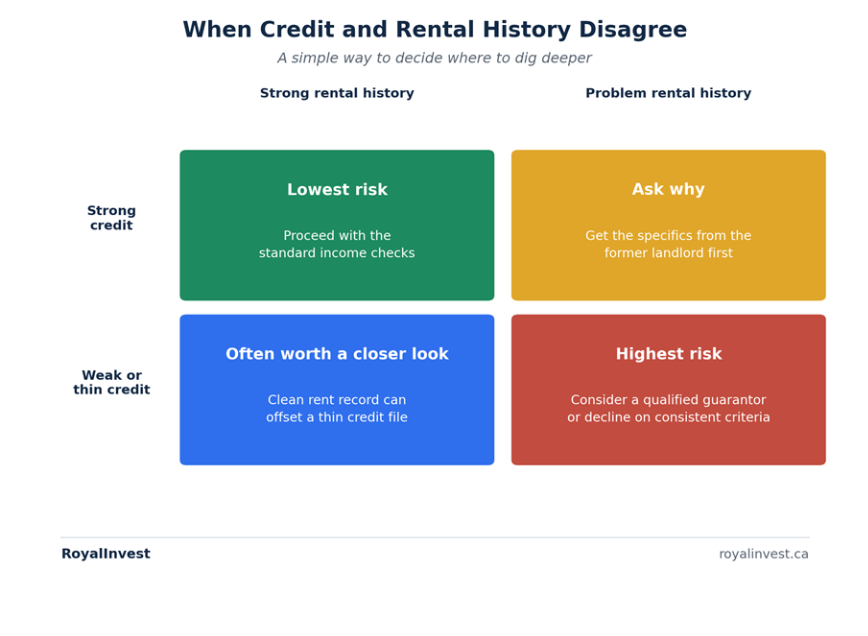
Figure 1: Where to dig deeper when credit and rental history disagree.
How to Weigh Them When They Disagree
When credit and rental history tell different stories, look at what is behind the mismatch rather than letting either record decide the outcome alone. Use these scenarios to guide a closer look.
- Strong credit, problem rental history: ask for specifics. A dispute over repairs is not the same as repeated missing rent.
- Thin or weak credit, strong rental history: often worth a closer look. A clean rent record is exactly what the Urban Institute data shows carries weight.
- Weak on both: the highest risk. A qualified guarantor, or declining consistent criteria, may be the right call.
- Strong on both: the lowest risk. Move on to income verification.
Worth a Look:
- Common Rent Collection Problems And How To Solve
- Monthly Rent Collection Workflows For Property Managers
- Why the Income-To-Rent Ratio Matters When Screening a Tenant
Why Rental History Is Harder to Verify
Credit files and rent records rarely line up. Credit reports tend to penalize missed rent while ignoring on-time rent, so a clean report cannot stand in for a reference. A few habits make references more reliable:
- Call two landlords. A current landlord may be glad to see a tenant move on, so the previous landlord adds a more neutral view.
- Confirm each contact is a genuine landlord, not a friend or relative.
- Ask factual questions. Was rent paid on time? Was the notice given? Was the deposit returned in full?
- Write down the answers and ask every applicant the same questions.
The goal is not to pick a winning record, but to understand the mismatch. Verify the details, document your reasoning, and apply the same criteria to every applicant.
Judging Both Fairly
Whichever record carries more weight in each case, hold every applicant to the same standard. In Ontario, human rights guidance calls for credit, income, rental history, and references to be considered together rather than as a single gate. A first-time renter’s missing rental history is missing information, not a negative, so decide in advance what other evidence you will accept.
How Royal Invest Takes the Guesswork Out of This
Reference calls are slow and subjective, so many landlords skip them or let a strong first impression stand in. The credit side gets the same treatment: a quick glance, a gut feeling, a decision. When both halves are informal, the outcome depends more on mood than on evidence.
Royal Invest takes the objective half off a landlord’s plate. A free tenant screening provides basic information up front, and the credit check pulls real bureau data with the tenant’s consent, no account needed on their end, and returns a plain-language summary, a risk level, and a clear PASS/FAIL recommendation in minutes. It complements the call to a former landlord rather than replacing it, giving every applicant a consistent credit read so the reference calls are the only part that takes real effort.
When an applicant clears both, the next step is an official lease agreement on the same platform.
Frequently Asked Questions
Is rental history more important than credit history?
Neither should stand alone. Rental history shows how someone has handled the specific obligation you’re asking them to take on, which makes it the closer match. Credit history is broader, easier to verify, and harder to inflate. Together they cover each other’s blind spots, so weigh both consistently.
What if an applicant has good credit but a bad rental reference?
Find out what actually happened before deciding. Ask the former landlord factual questions: was rent paid on time, was notice given, was the deposit returned in full? A dispute over repairs is different from repeated missed rent. Document the answers, and apply the same questions to every applicant.
Does a credit report show rental history?
Usually only partly. Unpaid rent that reaches a collection agency can appear, but on-time rent payments often never reach the credit file unless a rent-reporting service sends them. A clean credit report therefore doesn’t confirm a good rental record, so contacting previous landlords is still worthwhile.
How many previous landlords should I contact?
Contact the current landlord and, ideally, the one before. A current landlord may have reasons to give a favorable reference to encourage a move, so a previous landlord adds a more neutral view. Verify each contact is a genuine landlord, not a friend or relative.
What if a first-time renter has no rental history?
Treat it as missing information, not a negative. Look to other evidence of reliability: credit history where it exists, verified income, employer references, and a record of paying other bills on time. A qualified guarantor can also bridge the gap. Apply the same approach to every first-time renter.




Leave a Reply